
The landscape of the UK legal sector has undergone a profound shift as we move through 2026, particularly within the specialized niche of fiscal litigation and advisory services. For any established or boutique firm, appearing in a Tax Lawyers UK Online Directory is no longer a matter of simple digital presence; it is a critical component of a sophisticated practice development strategy. As the complexity of HMRC's digital oversight increases, the demand for high-level tax expertise has skyrocketed, yet the way clients discover this expertise has fundamentally changed.
In an era where traditional word-of-mouth is augmented by rigorous digital vetting, the quality of a firm’s online representation determines its success in the instruction phase. Legal professionals must recognize that a listing is a digital handshake—a first impression that must convey the same level of authority as a face-to-face meeting in a City boardroom.
The state of tax lawyers UK online directory platforms in 2026
The current market for legal services has seen a consolidation of how specialists are identified. A Tax Lawyers UK Online Directory now serves as a primary touchpoint for both high-net-worth individuals and corporate entities seeking clarity on ever-evolving statutory requirements. According to the Law Society's 2026 practice management survey, 73% of potential clients now conduct exhaustive research across multiple platforms before making an initial enquiry. This suggests that a firm's visibility is only as strong as the platform it inhabits.
Shifts in domestic fiscal litigation
What I am observing across the UK legal sector is a move toward hyper-specialization. Clients are no longer searching for generalists; they are looking for practitioners who can demonstrate specific success in VAT tribunals or R&D tax credit disputes. Consequently, directory profiles must now reflect these granular specialisms to remain competitive.
The rise of transparency in legal instruction
With the SRA's updated transparency rules now firmly embedded in practice, the expectation for clear, accessible information is at an all-time high. Directory platforms that provide comprehensive practice overviews allow firms to meet these regulatory expectations while simultaneously building a narrative of expertise and reliability.
Digital vetting and the modern client journey
The journey from a tax problem to a legal solution often begins with a search for tax lawyers UK. Five years ago, firms relied heavily on static websites. Today, they must leverage dynamic listings that offer social proof, such as representative work and detailed service specialisms, to capture the attention of a more discerning audience.
The evolution of professional social proof
In 2026, the integration of professional social links, particularly LinkedIn, directly into a directory profile has become standard. This allows potential clients to verify the professional pedigree of a partner or associate instantly, bridging the gap between a directory entry and a personal professional brand.
How client acquisition has changed for legal professionals
The methodology of acquiring high-value instructions has moved away from broad-spectrum advertising toward targeted, expertise-driven visibility. For those specializing in tax law, the challenge lies in demonstrating competence in a field that is notoriously opaque to the layperson.
The impact of initial research on conversion
Data from early 2026 indicates that 68% of clients value detailed practice area information during their initial research phase. They are looking for more than just a phone number; they want to see evidence of thought leadership. This is where legal services UK directories provide a distinct advantage by hosting legal articles and guides that demonstrate a firm's current knowledge.
Understanding the 82 percent threshold
An overwhelming 82% of potential clients now expect to see client FAQs and case studies before they consider reaching out for a consultation. This shift means that a bare-bones listing is effectively invisible to the modern client. The inclusion of a client FAQs section within a directory profile acts as a powerful pre-qualification tool.
Reducing irrelevant enquiries through specialisation
One of the primary marketing challenges for solicitors is the volume of irrelevant enquiries. By utilizing detailed service specialisms in a directory, a firm can effectively "self-filter" its leads. A firm focusing strictly on corporate international tax can ensure they aren't fielding calls about personal inheritance tax, thereby increasing the efficiency of their practice development teams.
The role of firm photography in trust building
Professional firm photography has been shown to increase enquiry rates significantly. In a high-stakes environment like tax law, seeing the faces of the legal team provides a human element to a technical service, fostering an initial sense of trust that is vital for conversion.
Why traditional legal directories no longer suffice
The directories of the past were often little more than digital phonebooks. In the current climate, these platforms fail to provide the context required for high-stakes legal decision-making.
The failure of static information
A static address and phone number do not communicate the nuance of a firm's culture or its recent successes. Modern platforms allow for firm news and updates, ensuring that the profile remains a living representation of the practice’s current capabilities and market wins.
Lack of engagement tools
Traditional directories lacked direct engagement capabilities. Today’s professionals require direct messaging with potential clients and direct client enquiry forms to ensure that the moment of peak interest is captured immediately, rather than lost to a delayed email response.
The absence of video content
Video introduction capability has emerged as a differentiator for forward-thinking firms. A sixty-second clip of a lead partner explaining their approach to tax disputes can be more persuasive than three pages of text, providing a sense of the advocate’s personality and communication style.
Ignoring the document download trend
Clients in 2026 are proactive. They look for document downloads, such as whitepapers on the latest Finance Act or guides to HMRC investigations. If a directory platform cannot host these assets, it is failing to serve the client's need for initial value.
A modern approach to legal practice visibility
Adopting a modern approach means viewing the Tax Lawyers UK Online Directory as an extension of the firm’s own digital ecosystem. It is an opportunity to broadcast expertise to a wider, yet highly relevant, audience.
Integrating case studies for impact
Case studies and representative work are the backbone of a successful tax practice profile. By detailing a successful outcome in a complex tax tribunal (while maintaining client confidentiality), a firm provides the "reason to believe" that prospects require.
Leveraging webinar and event listings
Many tax firms now use webinars to educate their clients on upcoming legislative changes. Integrating these event listings into a professional profile ensures that the firm is seen as an active participant in the legal community, rather than a passive service provider.
The power of peer networking
Visibility on a reputable platform also facilitates referral opportunities. Often, solicitors in other fields (such as family law or property) use these directories to find specialist tax counsel for their own clients, making the directory a hub for B2B networking.
Managing a practice wide visibility
For larger firms, ensuring that every department has visibility is a logistical challenge. A multi-practice area listing allows a firm to be discovered under various categories—from tax lawyers UK to corporate litigation—ensuring that no part of the practice is left in the dark.
Case study a London firms experience
As Sarah Chen, partner at Chen & Co Solicitors, told me during a recent interview, "The shift to specialized directories was the single most effective move we made for our tax department in 2025. We stopped chasing the general market and focused on where our clients were actually looking."
Identifying the core problem
Before their digital pivot, the firm was seeing a plateau in new instructions despite a high-performing team. They realized that while their expertise was top-tier, their visibility was confined to their own website, which had limited reach.
Implementing a directory strategy
By creating a comprehensive law firm profile with a practice overview on a leading directory, they were able to showcase their specific expertise in cross-border corporate tax. They utilized the video introduction feature to introduce their lead partners and uploaded several legal guides regarding post-Brexit tax compliance.
The result of targeted visibility
Within six months, the firm saw a 40% increase in qualified enquiries. By providing a clear practice area specialisation, they reduced the time spent on irrelevant calls and increased their conversion rate for high-value corporate instructions.
Future outlook for the firm
By late 2026, we'll likely see this firm further integrating their live news updates into their profile to maintain their position as market leaders. They have demonstrated that visibility, when coupled with expertise, is a formidable tool for practice growth.
Selecting the right platform for your practice
Choosing where to list your practice is a strategic decision that should be based on the platform's ability to represent the professional nature of tax law.
Evaluating profile depth
Does the platform allow for a detailed service specialisms list? In tax law, the difference between "tax advice" and "SDLT mitigation" is vast. A directory must allow for this level of granularity to be useful to both the solicitor and the client.
Assessing engagement features
A platform should offer more than just a link. Look for features like direct messaging and enquiry forms that integrate into your existing workflow. This ensures that the digital directory acts as a functional part of your business development engine.
Considering the search engine impact
The authority of the directory itself matters. Platforms like Local Page provide a reputable environment that search engines recognize, helping your firm appear when potential clients search for terms like tax lawyers UK.
The benefit of free listing options
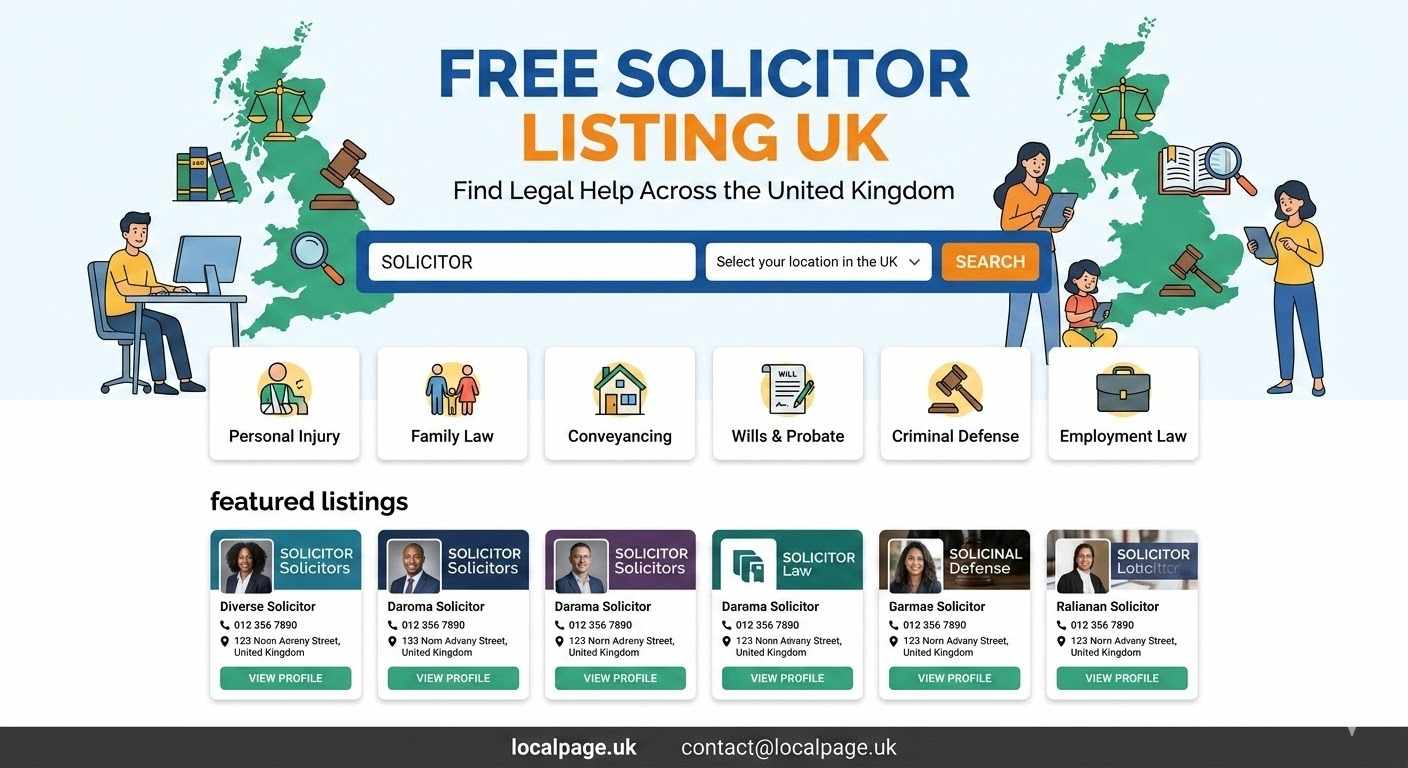
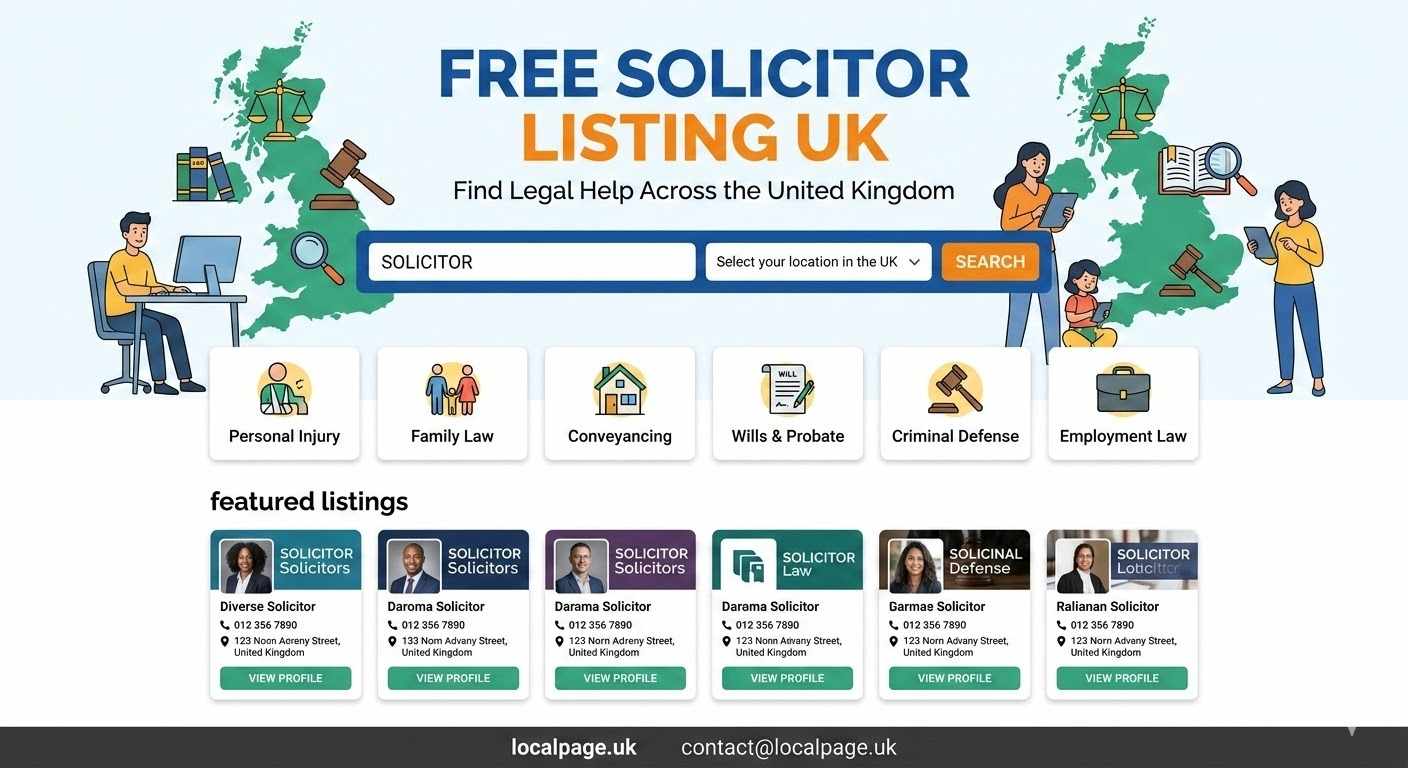
For smaller firms or independent consultants, free solicitor listing UK options are an excellent way to gain a foothold in the market without significant overhead. This levels the playing field, allowing expertise to shine through regardless of firm size.
Strategic recommendations for UK solicitors
As we look toward the remainder of 2026 and into 2027, the role of digital directories will only become more prominent. My recommendation for any tax professional is to take ownership of their digital narrative immediately.
Audit your current digital presence
Start by searching for your firm as a client would. Are you appearing in the places where legal services UK are most commonly found? If your only presence is your own website, you are missing out on a significant portion of the market.
Invest in high quality assets
Do not underestimate the power of professional photography and well-written case studies. These are the elements that move a prospect from "just looking" to "ready to instruct."
Maintain your listing regularly
A directory profile is not a "set and forget" asset. Update your firm news, add new representative work, and ensure your FAQs reflect the questions you are currently hearing from clients in your office.
Align with regulatory standards
Ensure that your profile is fully compliant with the latest SRA guidelines regarding transparency and professional conduct. A well-managed directory listing is one of the easiest ways to demonstrate this compliance to the public.
FAQ
How do I choose the right solicitor for tax law matters?
Choosing a tax solicitor requires looking beyond general legal credentials. You should seek a firm that demonstrates specific experience in your area of concern—whether that is corporate restructuring, HMRC disputes, or private wealth. Reading through their case studies and representative work on a directory profile is an excellent way to gauge their suitability for your specific case.
What information should a law firm include in its directory profile?
A comprehensive profile should include a detailed practice overview, professional photography of the team, specific service specialisms, and links to professional social media. Furthermore, including document downloads such as legal guides and a section for client FAQs can significantly enhance the trust a potential client feels before they even make contact.
Are there free options for listing my legal practice?
Yes, many high-quality platforms offer a free lawyer listing UK to help firms get started. Using a service like Local Page allows you to establish a professional presence and test the efficacy of the directory without any initial financial commitment, which is particularly beneficial for boutique practices and new start-ups.
How can I verify a solicitor's credentials and expertise?
In the UK, you should always check the Solicitors Regulation Authority (SRA) register. However, a directory profile often provides additional context, such as professional social links (LinkedIn) and articles written by the solicitors, which can give you a better sense of their standing in the legal community and their specific areas of expertise.
What questions should I ask before instructing a solicitor?
Before formal instruction, ask about their experience with cases similar to yours, the likely timeline for your matter, and who will be your primary point of contact. Many firms provide this information upfront in their directory FAQs, which can help you prepare for your initial discussion.
How do solicitors typically structure their fees?
While fee structures vary, most tax solicitors work on either a fixed-fee basis for specific projects or an hourly rate for ongoing advisory or litigation work. It is important to discuss this during your initial consultation to ensure clarity and avoid any future misunderstandings regarding the scope of work.
What should I expect during an initial consultation?
During an initial discussion, the solicitor will typically review the facts of your case, identify the key legal issues, and provide a preliminary view on the possible courses of action. This is also your opportunity to assess their communication style and professional approach to ensure they are the right fit for your needs.
How long do tax law matters usually take?
The duration of a tax matter can vary wildly—from a few weeks for a simple advisory piece to several years for complex litigation involving HMRC and the courts. A specialist solicitor will be able to provide a more accurate estimate based on the specifics of your situation and the current backlog in the tribunal system.
Can I switch solicitors if I am not satisfied?
Yes, you have the right to change legal representation at any time. If you feel your current solicitor is not meeting your expectations or lacks the specific expertise required for a developing tax issue, you can research alternative specialists through a tax lawyers UK directory to find a firm that better aligns with your requirements.
How do I arrange an initial discussion with a specialist solicitor?
Most modern directory profiles include a direct client enquiry form or a direct messaging feature. Simply provide a brief overview of your situation through these tools, and a member of the firm’s tax department will typically reach out to schedule a formal call or meeting.
For further assistance or to manage your practice's digital presence, you may reach out via the contact details provided below.
Contact Information Email: contact@localpage.uk Website: www.localpage.uk








Write a comment ...